

In recent days there has been a lot of talk in the news media about Air New Zealand airfare pricing. Last Thursday consumer rights group Consumer NZ sent out a press release criticising Air New Zealand for airfare price increases with bold claims of increases of up to 300%, and we saw the press release being lapped up by media and covered extensively without any real critique or fact checking of a study that wouldn't even pass the smell test in a high school statistics class.
For anybody like myself who travels extensively and has knowledge of the industry the story rang alarm bells - Consumer NZ have shown themselves to deliver some highly questionable viewpoints about consumer issues in recent years, and this story in particular was no different. Having heard Consumer NZ CEO Jon Duffy discuss airfares in several radio interviews over the past year or so it is plainly clear to anybody with even a little knowledge of the aviation or travel industries that he lacks even a basic knowledge of airline pricing and in my opinion would probably be best not talking about things that he simply doesn't understand.
Airline pricing across the world isn't like a loaf of bread at a supermarket where every customer who visits the store that day, or even that week, pays the same price regardless of when they visit. Airlines all use fare booking classes, and in the case of Air New Zealand, have 15 different fare booking classes for domestic airfares. Rather than every seat on the plane being sold for the same price, there are up to 15 different priced fares available for every flight.
There are also four different fare basis levels available (seat, seat+bag, flexichange and flexirefund) meaning up to 60 different fare combinations on a single flight. If you were to stand up on a plane and ask everybody how much they paid for their ticket you are going to get a lot of different answers, and more than likely find the person next to you possibly paid either a lot less or a lot more than you.
To show this pricing in the real world I'll use Hamilton as it was an destination used by Consumer NZ for one of their examples. The following shows the current Air New Zealand pricing and fare levels from April 2024 for a one way seat only flight from Hamilton (HLZ) to Wellington (WLG) or vice versa. There are only 14 booking classes shown here as Grabaseat Greenlight fares use F class, which is something we will discuss later on.

Typically speaking when most airlines open up bookings for flights around a year out they sell the cheapest fares first, and as the plane starts to fill up the price of airfares goes up.
When customers buy airfares from the Air New Zealand website they are sold the cheapest booking class that is available at the time. Air New Zealand opens up bookings 350 days out, so if you want to book flights that far out you've got a pretty good chance of picking up P class seats that are the cheapest available fare on that route. As the example below shows there is plenty of availability (7 seats on that flight actually) of $79 P class fares for June 2025.
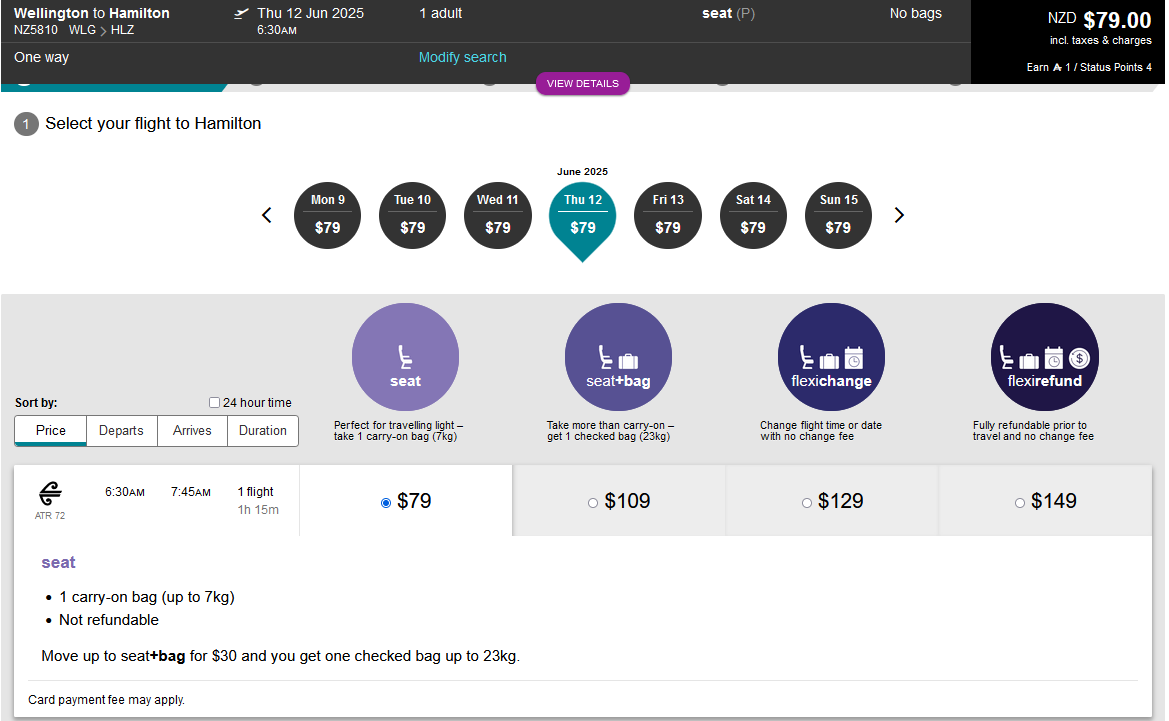
Once the allocation of P class fares are all sold, the booking engine will begin selling K class fares for $89, and once they're all sold will begin selling X class fares for $100.. and then G class for $119 and then S class for $136 and so on.. This goes on until the flight is full.
Air New Zealand may not release fares for every booking class for a flight, and may not necessarily release fares in cheaper booking classes for every single flight. As you can see from the example below the cheapest fares available on some flights on the same date are X class fares for $100. It is highly likely that Air New Zealand know that demand for travel on these flights is much greater than an early morning departure and therefore decides it has no need to sell cheaper fare classes on these flights.
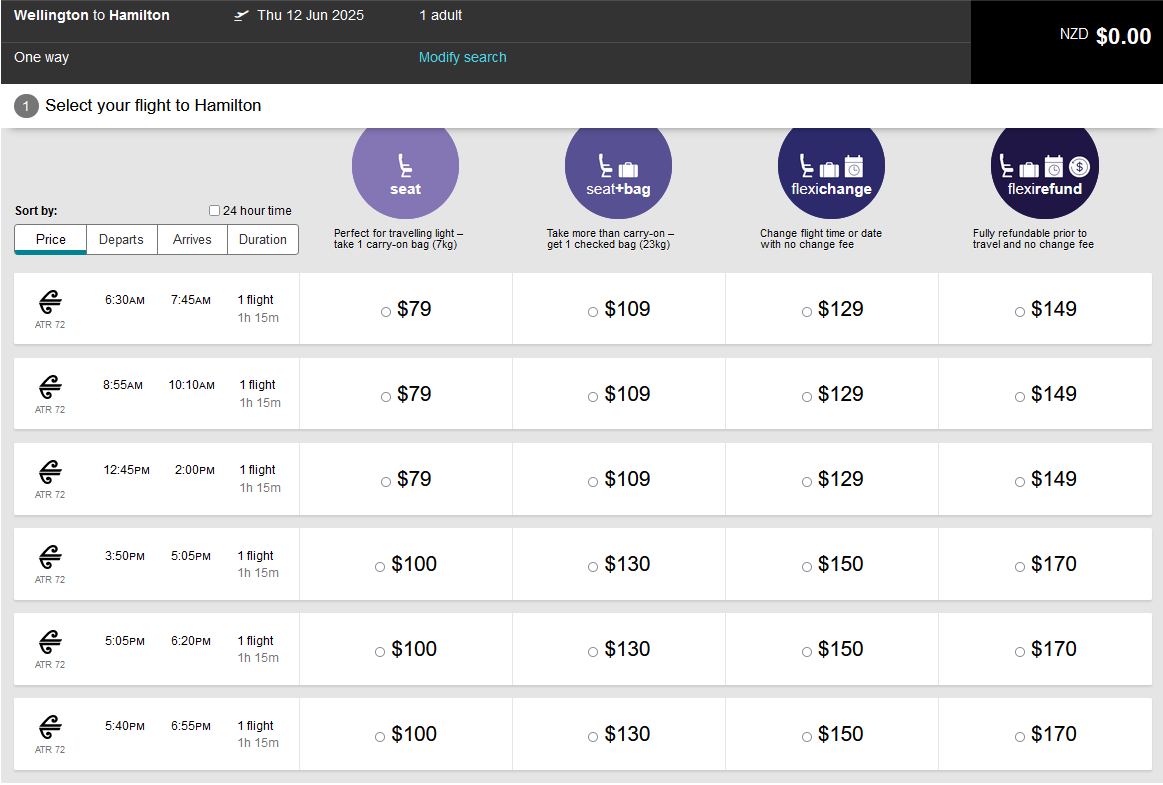
What none of us outside Air New Zealand's revenue management team know is exactly how many seats at each fare booking class Air New Zealand allocate for each flight. This is not a fixed number for every flight, and at any point in time Air New Zealand can decide to make cheaper classes available, even if these had sold out prior. Revenue management is critical to every airline, and the people and computer algorithms that set pricing are one of the most important parts of the business.
Now that I've hopefully explained a few simple basics about how airfares work and how different they are to a loaf of bread in a supermarket, lets introduce some more data and learn a few more things. Here is pricing data from not only April 2024, but June 2022 and April 2018. You can see how airfares have changed over time with the prices of flights in higher booking classes now more expensive than they were in 2018, but with prices of many lower booking classes cheaper now than they were in 2018.

Air New Zealand has publicly stated that they have seen massive cost increases in the day to day running of the airline with costs up well over 30% from Pre Covid levels, and in February it cut its pre tax full year profit guidance by between $40m and $50m due to increasing costs and worsening market conditions.
The airline has been pretty open about increases in airfare prices to cover these increased costs and says that airfares are now up over 20% across the board. Aviation fuel is its biggest single cost input, and the price of oil in recent years has risen significantly, along with the exchange rate being hampered by the New Zealand dollar trading at reasonably low levels.
Looking at the above table you might think that airfares haven't actually changed much but that is only partially true - airlines don't necessarily need to change prices because they can do a fairly good job of managing things simply by changing the allocation of different fare booking classes on a plane. By allocating fewer seats in cheaper booking classes and more seats in higher priced booking classes it pushes the average seat cost up across the whole plane.
Most entry level fare classes are sold at a loss by the airline - somebody buying a $79 P class fare from Wellington to Hamilton probably doesn't realise that the airfare that they have purchased doesn't actually cover the cost of flying the plane, and that the person who may be sitting next to them that had purchased the $400 Y class fare is in effect subsidising their airfare. Achieving the right balance of booking classes on each flight is critical, because if you sell too many cheap seats you'll operate at a loss. Try and sell every seat at $400 and nobody will fly.
Despite what some commentators and general public may think, the prices of airfares in New Zealand are actually pretty reasonable if you are to benchmark pricing with many countries overseas.
One such example I like to mention is the difference between New Zealand and Australia - the route between Sydney and Melbourne is the fifth busiest in the world and yet as I type this a last minute economy fare on Qantas for travel today between Melbourne and Sydney on multiple flights is AUD$1031 for an economy fare. The maximum priced fare between Auckland and Invercargill, Auckland and Dunedin or Auckland and Quenstown which are all similar or slightly longer duration flights is NZ$520 for a full Y class fare.
When people talk about airfares "going up" they are rarely ever making fair comparisons. One of the issues that the industry saw on domestic flights in New Zealand as well as international flights both in out of New Zealand in 2023 was incredibly strong demand for flying as the Covid recovery took place. Due to cutbacks which had occurred during Covid as airlines parked up and eliminated old aircraft, many airlines simply don't have enough aircraft to operate as many flights as they did pre Covid. As a result many flights flew at or near capacity, and many Air New Zealand customers booking long-haul travel would have found that using Recognition Upgrades was near impossible due to Premium Economy and Business Premier cabins being full of paying customers.
While the costs of flying has increased, people have also been booking a lot of travel much closer to their travel times. Somebody booking flights a month or two out when a flight is only half full may typically find they can pick up an airfare in a midrange booking class such as L, T, W or V. If you booked a few days out when the flight was virtually full you'd probably end up finding that the only seats left might be a M, B or Y airfare. The "price hasn't gone up" per se, but once again due to the fact airline tickets are not a loaf of bread sold to every customer at the same price, you're paying the price that the airline as deemed necessary to charge to to operate the service.
Now that you've hopefully got an understanding of how airfares are set, we can look at examples by Consumer which show how poor their research and methodology are and why their claims simply don't stack up.
In their press release during the week Consumer NZ used an example of flights from Wellington to Hamilton increasing by 297% -
A return flight to Hamilton for two adults with no luggage, booked just 2 days before a funeral, cost a modest $281.20 in 2021. Three years later, the same flight booking would cost $1,118.00
Since we don't know exactly what dates in 2021 they flew I can't reference fare tables but we know they probably paid $69 each way for a return flight two days out. When Consumer NZ tried to book the same flights in 2024 two days out they cost $279 per person each way (which doesn't map to a fare class either post April or pre April so I'm not sure where their price came from - maybe it includes credit card fees). As you can see this isn't even close to being a maximum priced airfare which is $400 per person each way.
It is also worth noting that Air New Zealand offer compassionate fares where travel is for an unexpected medical emergency or a bereavement. If passenger(s) meet the criteria of this policy, airfares are a fixed $169 one way for a single sector, or $249 one way for two or more sectors.
I thought I'd take a look at current prices to book a flight between Wellington and Hamilton two days out.. and believe it or not there are actually $89 airfares available every day this week.
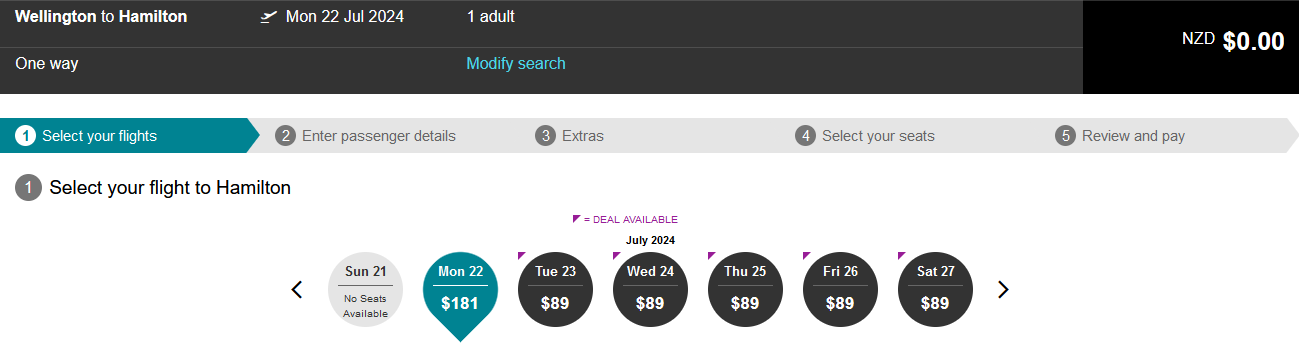
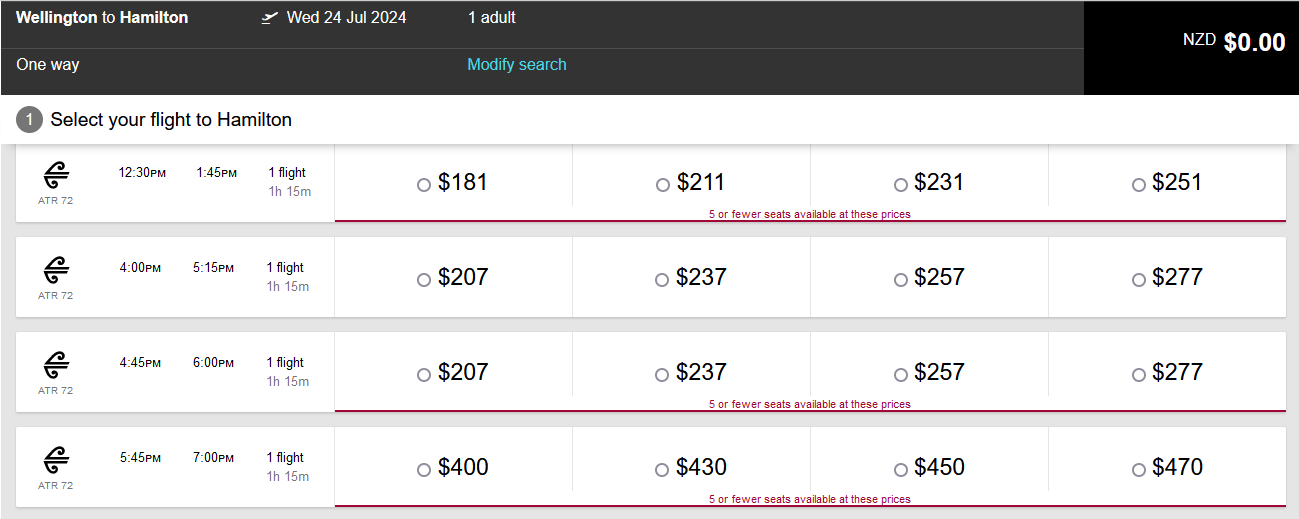
So two people could fly return to Hamilton on Wednesday this week booking two days out and pay $89 each on the 6:30am flight and $181 each on the 7:35pm flight back - I think that's pretty reasonable. If they had wanted to stay in Hamilton for the night they could have purchased an airfare back the following day for $89. So why did Consumer make such a big deal about flights costing so much? Did they make valid comparisons? Was it a busy period for travel where flights were mostly full? Did they simply chose expensive fares rather than cheaper ones? We simply don't know. All we know is they chose an example and tried to make a headline of a 297% increase.
Now that you understand how airfares work you realise how stupid this really makes Consumer NZ look... Using their same logic if I'd booked a $380 return flight in 2023 and could now pick up return flights for $188 then using their logic prices must have dropped by 50% - except they haven't.
Of course if you want to fly at a busy time you can easily pay more - right now there are only two seats remaining on the 5:45pm flight back to Hamilton on Wednesday that are full Y fare at $400 each.
Consumer NZ also used an example of travel to Australia in March 2020
A flight for a family of four from Sydney to Palmerston North, made in March 2020, 2 days before New Zealand’s first nationwide Covid-19 lockdown was announced, cost $1,372 in total. Today, the same flight costs $3,451 – two and half times what it cost 4 years ago.
For those of us who don't have short memories we still remember the bargain airfares that airlines had on offer weeks out from our Covid lockdown in March 2020. Air New Zealand were offering airfares for as low as $69 one way from New Zealand to Australia due to the fact people simply weren't flying. You could book flights to Australia for $200 return which only covered the cost of taxes and service charges for the return flight (I know because I booked a number at such a bargain price!)
How can you compare the dirt cheap airfares on sale pre Covid with a regular priced fare from Palmerston North to Sydney in 2024 and claim that it costs so much more? You simply can't. We know that airfares from New Zealand to Australia have gone up and so too have taxes and service charges - for a return flight from Wellington to Sydney taxes and charges now cost $300.11 whereas in early 2020 those same taxes, surcharges, government and airport costs were $191.58 for a return flight to Sydney. That is an extra $110 on top of all airfares and the airlines don't see a single cent of that.
Right now for a random flight booking from Wellington to Sydney taxes and charges that go straight to airports and Government agencies make up $300.11 of a $691 airfare

The days of a $343 return flight to Sydney is not something we're going to see ever again unless airlines want to sell seats at a massive loss. That would mean $43 of revenue for the airline for two flights which is not even close to covering costs.
Consumer NZ made other such claims about airfares all of which can be easily dissected and pulled apart to show that no real thought went into their actual comparisons. Comparing the cost of only 11 flights from 2023 and 2024 with flights from 2019 and 2020 when the airline operates thousands of flights every week is such a small sample that it's laughable to think they see this as a valid comparison.
We know that cost of flying has gone up in recent years - Air New Zealand have been open about this, and data collected by Statistics New Zealand who's methodology is far more robust than Consumer NZ sample significant numbers of flights as part of their Consumer Price Index (CPI) calculations. After rises in 2023 their data in recent months has actually showed the price of both domestic and international airfares dropping, with domestic airfares down -0.5% in June 2024 compared to May 2024, and down -4.2% in June 2024 compared to June 2023. May data showed domestic airfares down -7.9% compared to April 2024, and down -0.7% in May 2024 compared to May 2023
While Consumer NZ spend their time trying to keep themselves relevant with poorly researched data that gives them their five minutes of monthly media airtime that does nothing but cause consumer outrage, their failure to actually understand even the basics of the airline and travel industry means they overlook many issues of Air New Zealand's airfare pricing that they really should be focusing on making a big deal about. They should be jumping up and down and telling all of their own members how to ensure they get the best deal on flights.. But they don't.
What if I told you that most people are doing things completely wrong when they're looking for the best flight deals on Air New Zealand? What if I told you there was a simple way to find cheap flights that may not be obvious to a lot of people?
If you're a typical Air New Zealand customer you probably just browse to www.airnewzealand.co.nz when you want to book flights - but did you know that by booking all your flights using Air New Zealand's Grabaseat site at www.grabaseat.co.nz you could well find your flights cost significantly less? I have written about Grabaseat a lot over the years, and it's something that many people are still unaware of.
In 2006 Air New Zealand launched the Grabaseat site to offer discounted flights that were typically for travel a few months out. With most travel at the time still being booked using a travel agent, and holidays planned well in advance, it was a way of offering passengers great deals on flights and was a way for the airline to grow it's online business by offering fares that were cheaper than those that could be offered by travel agents. Over time Grabaseat has evolved into a site that offers a combination of two different types of offering - "Grabaseat" fares and "Grabaseat Exclusive Greenlight" fares.
Most Grabaseat deals are for travel at least two to three months out, with fares normally booked into P class. The same priced P class fares are typically available on both the Grabaseat and Air New Zealand websites. Grabaseat Exclusive Greenlight deals are available for travel typically within the next one to two months and are typically booked into F class. F class fares are not available on the main Air New Zealand website and are only visible from the Grabaseat website, a key point I will get to shortly.
F booking class is a special class that does not earn Airpoints Dollars but does earn Status Points. International flights booked into F class are also ineligible for upgrades meaning you can't lodge a Recognition Upgrade, an Airpoints Dollar upgrade, or bid for a OneUp upgrade on a F class airfare. F class international fares have be kept separate from the main Air New Zealand site because they are in effect a discounted fare that does have restrictions on it that do not apply to any flights booked on the main Air New Zealand website.
F class domestic fares are identical to other domestic fare classes with no restrictions, with the only difference between the fare types being that they do not earn Airpoints Dollars.
The screenshots below show the availability of airfares using the Air New Zealand and Grabaseat websites over the next month for flights between Wellington and Hamilton. As you can see there is a huge difference between the two, with $89 F class Grabaseat Exclusive Greenlight airfares being available across the majority of days over the next month, whereas the Air New Zealand website has $89 K class airfares available on a single date only.
If you were a customer looking to book flights to Hamilton using the Air New Zealand website you'd see that on most days the cheapest airfare you could book is $181. If you were a customer who used the Grabaseat website to search for the very same flights you would see multiple $89 options on most days.
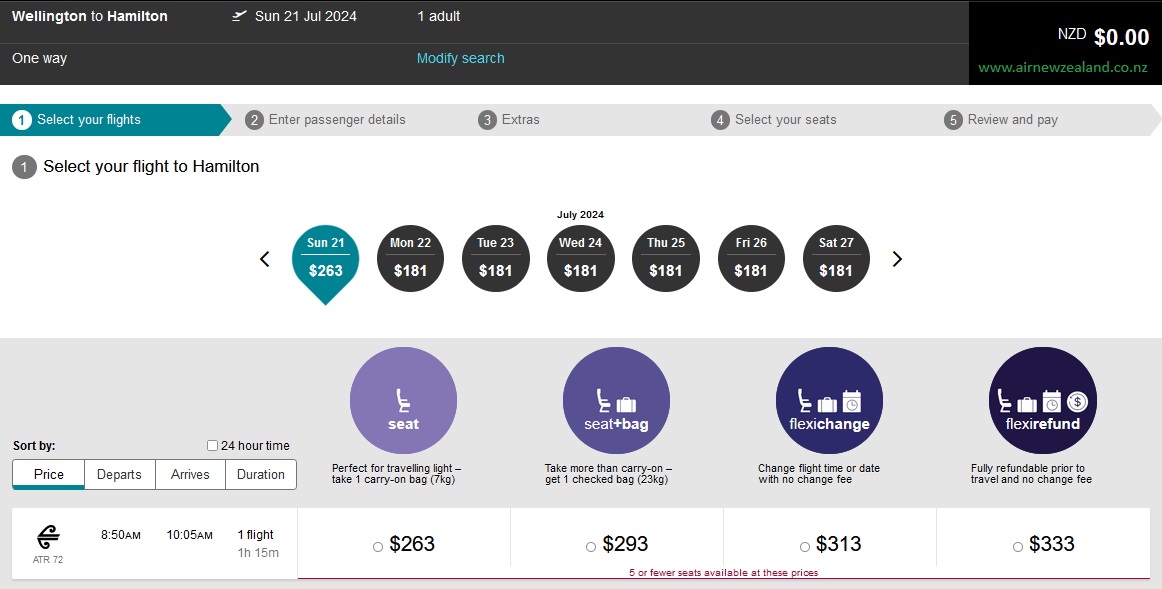
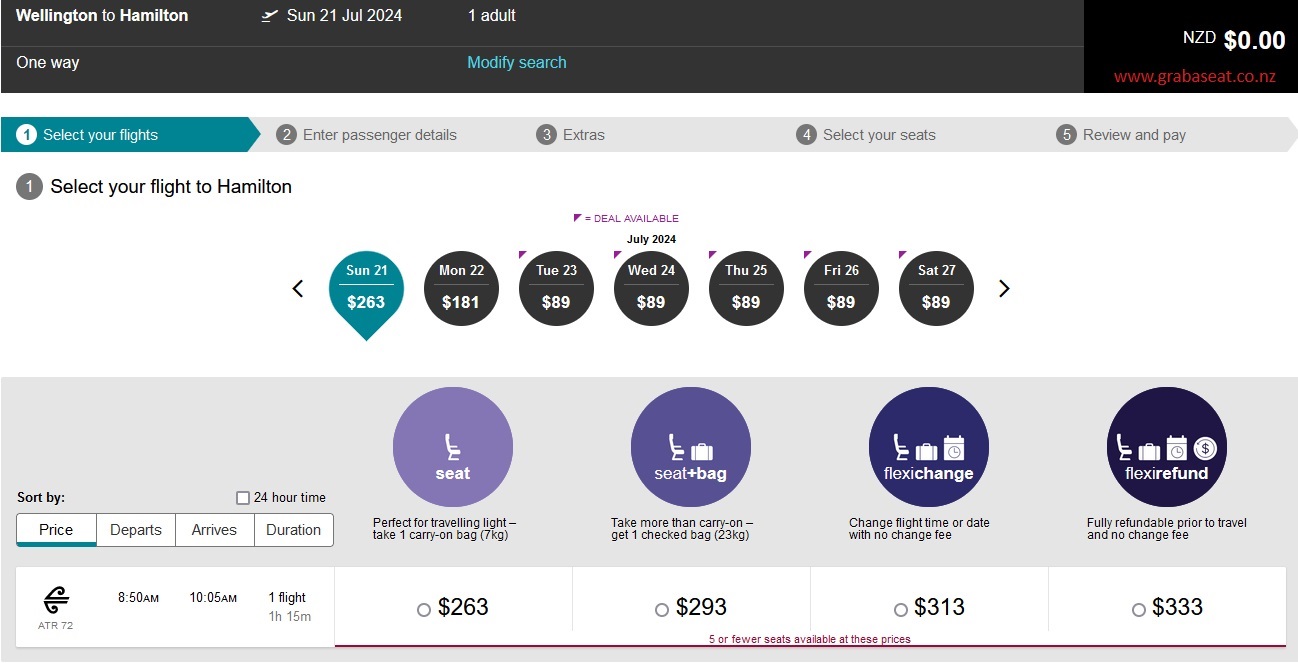
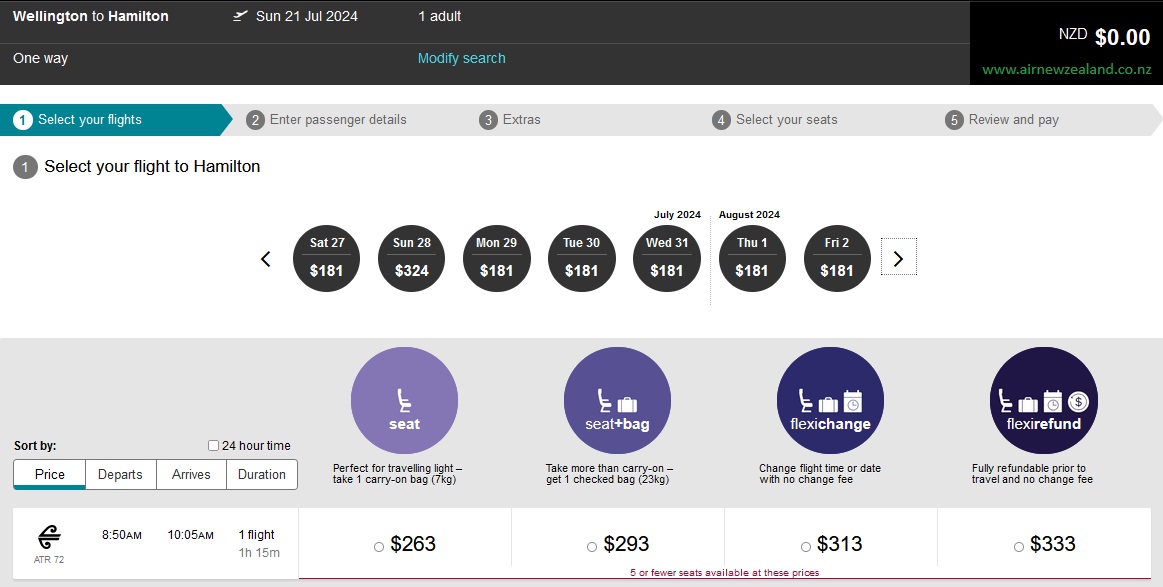
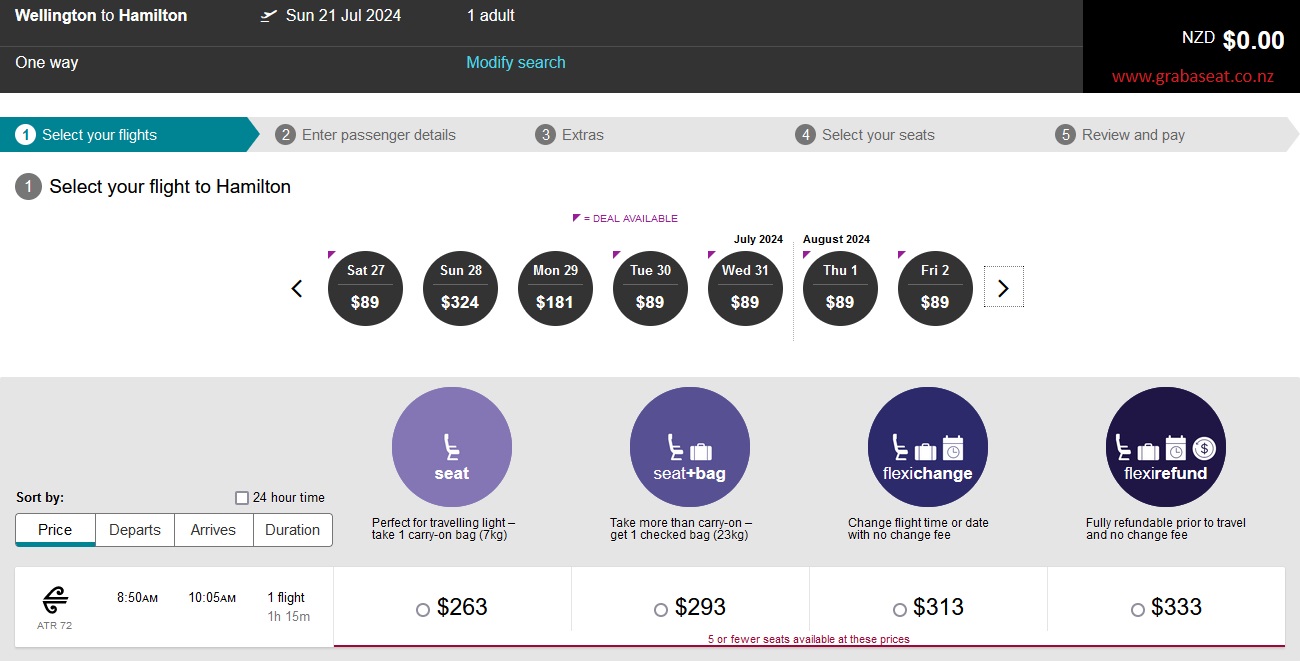
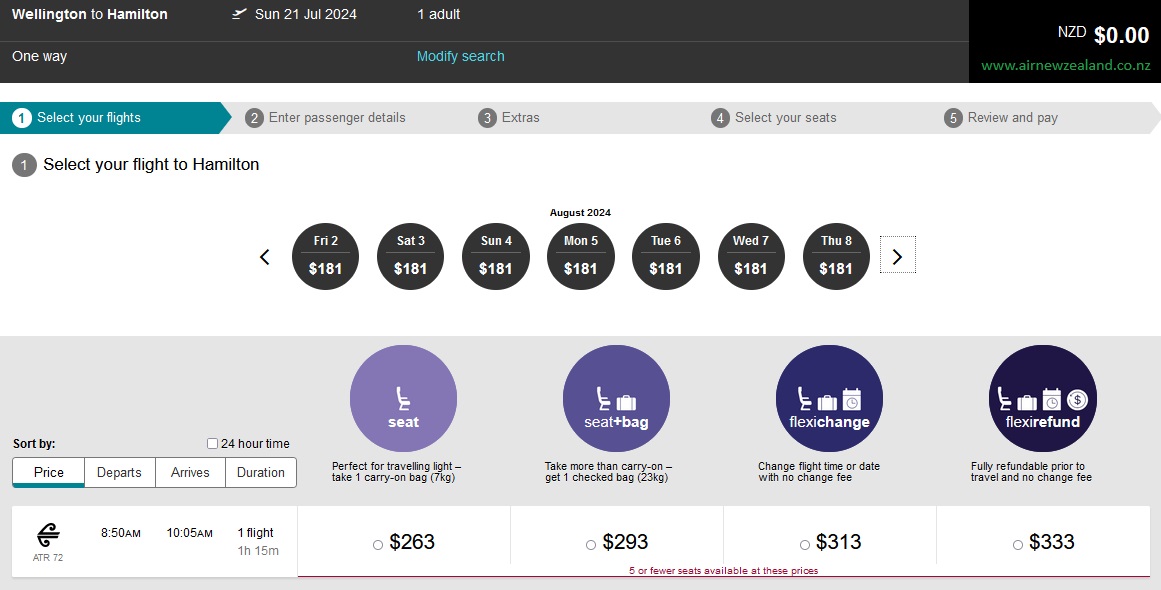
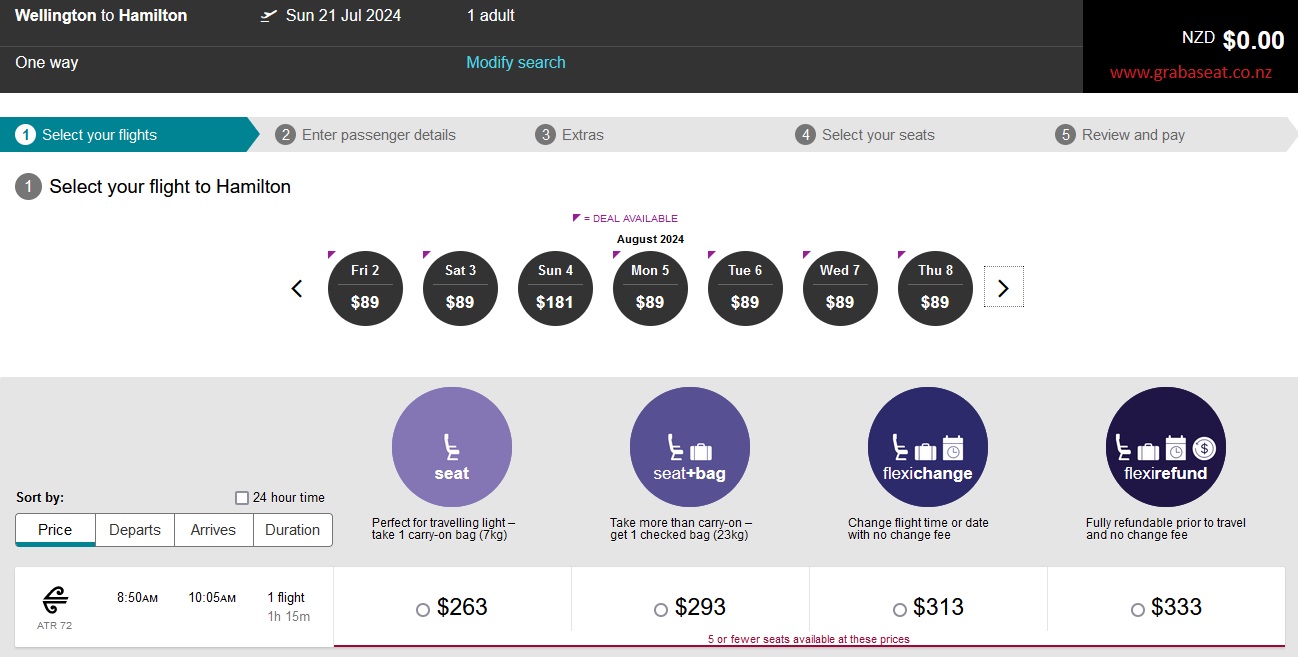
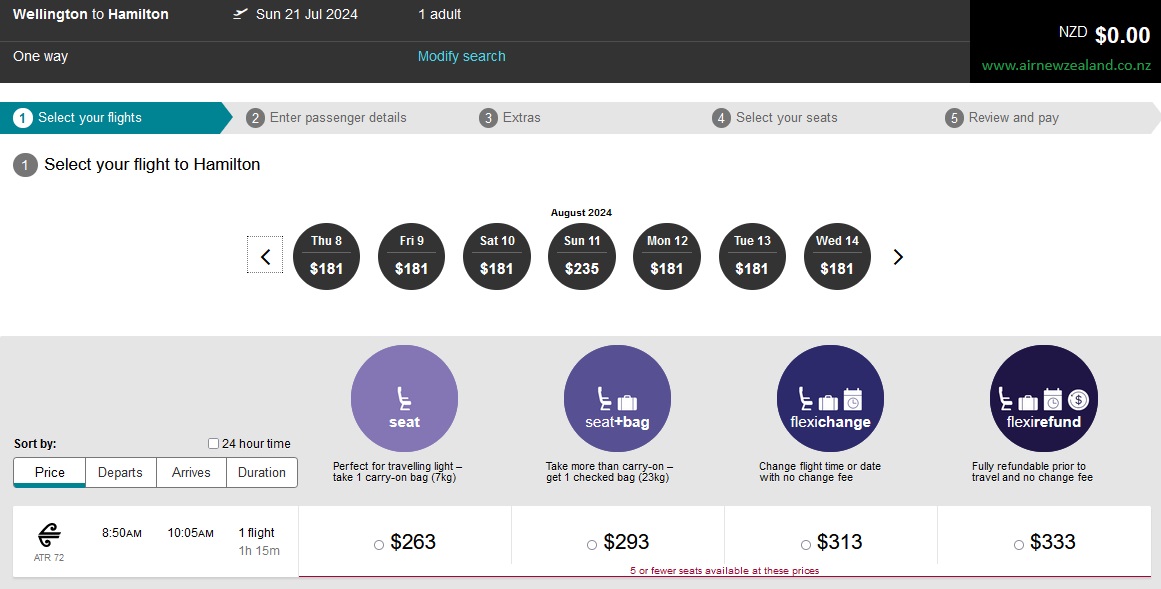
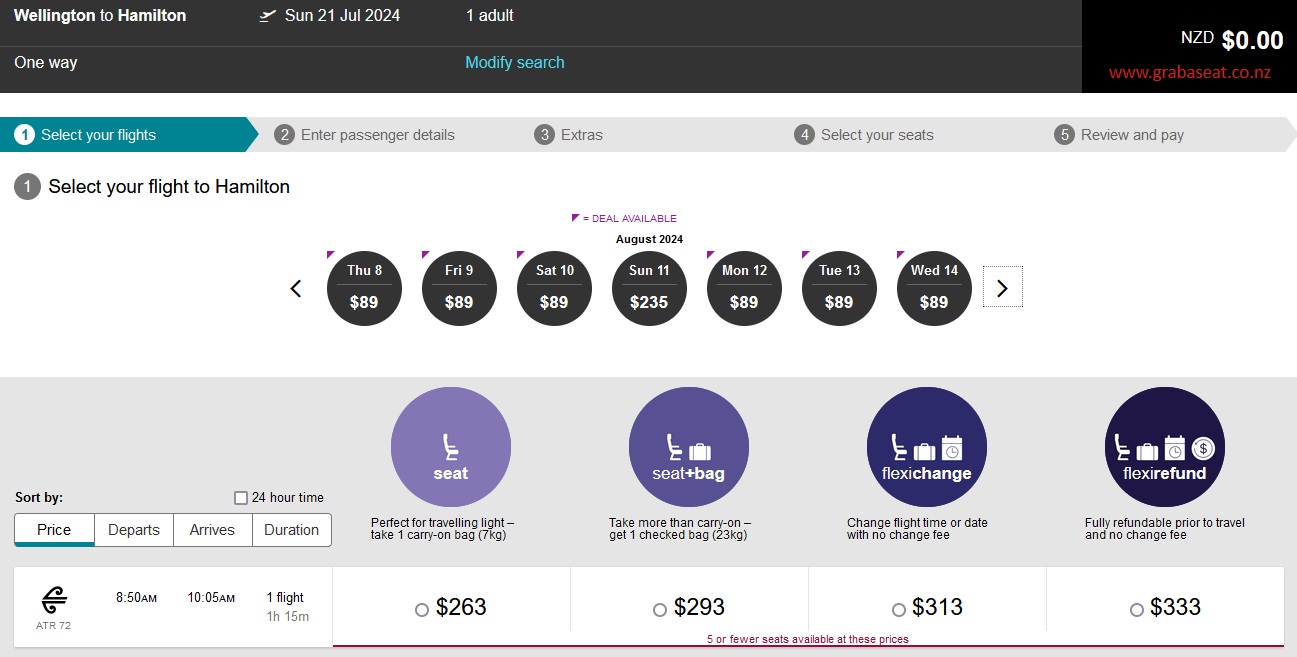
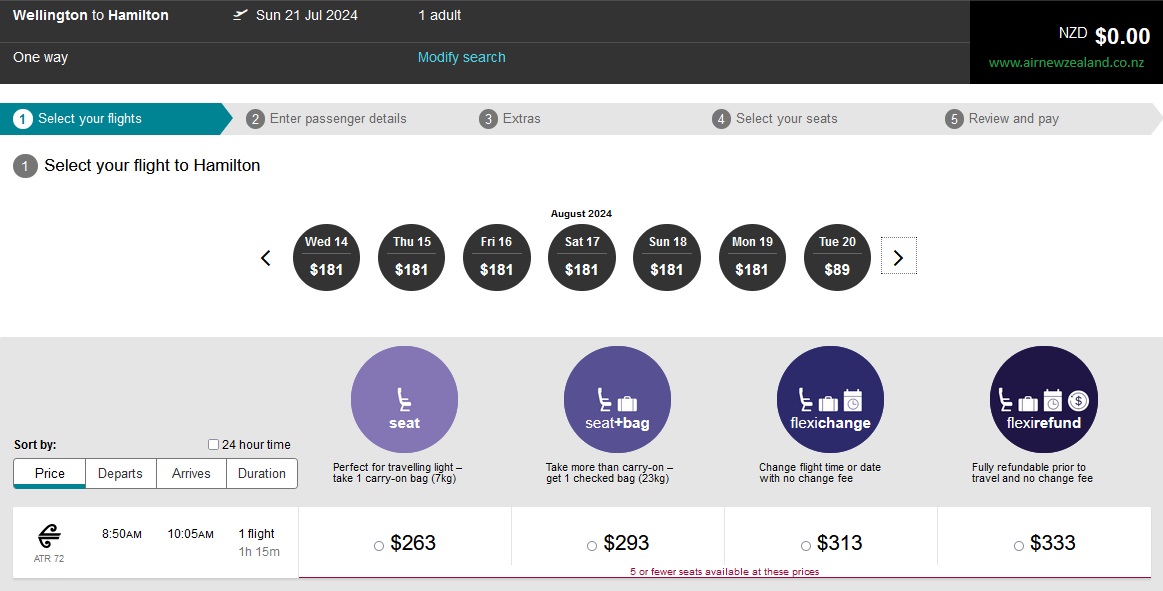
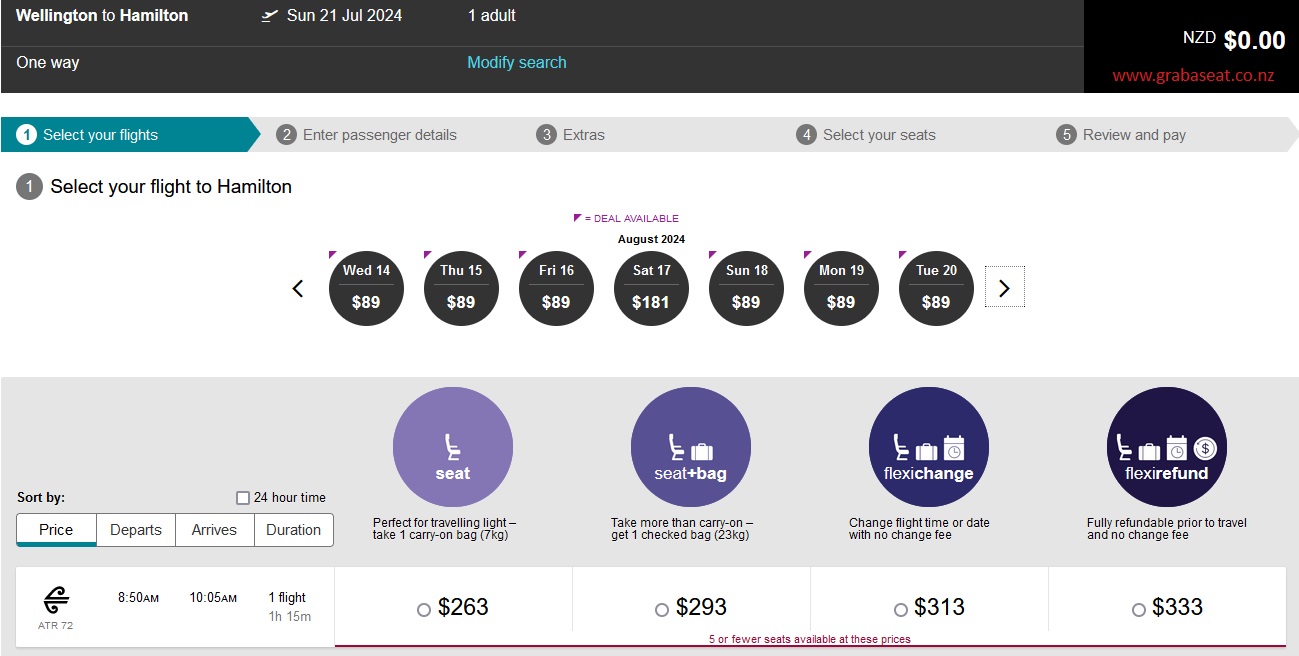
Now I need to make it clear that not every flight on every day has $89 F class Grabaseat Exclusive Greenlight airfares. On many days there may only be $89 seats available on one flight. On other days there may be $89 seats available on a number of flights. Typically speaking these cheaper fares will be available on flights at off-peak times rather than flights at peak travel times as the example below shows.
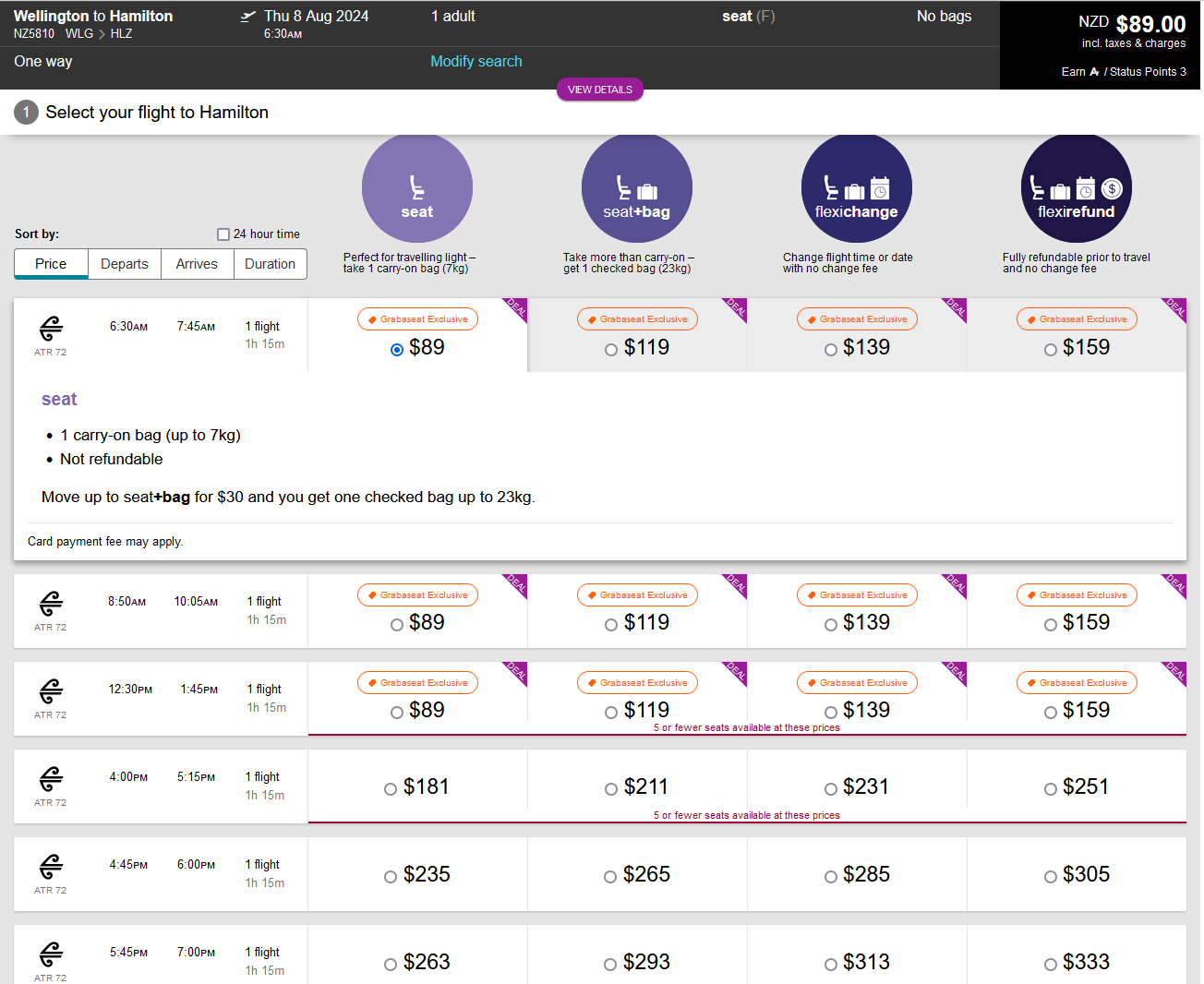
So you're probably asking yourself.. Why are Air New Zealand doing this? And didn't you just explain above how booking classes work and why airfares get more expensive closer to the time of travel? Yes I did. I am now going to backtrack just a little...
The goal of any airline is to fill as many seats as possible on a plane, a term in the industry called the "load factor". Air New Zealand had a domestic load factor of 78.9% in May 2024 and a 84.7% load factor on the 2024 financial year to date - this means they sold 78.9% of all seats available on their flights in the market in May 2024, and 84.7% of all seats on their flights in the financial year to date.
Some flights and routes are always going to be more popular than others, and we know that Friday afternoons and evenings are always a busy time for main trunk jet flights particularly on the Auckland<->Wellington and Auckland<->Christchurch routes due to the high numbers of business travelers. Many of these flights will regularly be completely full, so there is no need for the airline to offer discounted seats.
On other routes things can be quite different. Flights between Wellington and Hamilton have significant numbers of business travelers but it would seem pretty clear that over the coming month that load factors on many flights may not be as high as Air New Zealand are expecting so they've decided to offer discounted Grabaseat Exclusive Greenlight fares to sell seats and fill up planes. If the plane is going to fly and you know it's not going to be full then you might be able to sell a few seats on that flight for $89 which from a revenue perspective is better than the seat remaining empty.
But one question remains unanswered still.. Why do Air New Zealand only sell these cheap (typically) last minute airfares on the Grabaseat and not the regular Air New Zealand website? That's a question I can't answer but the only real assumption is that Air New Zealand want to offer these fares to the market but like a secret club don't actually want too many people to know about them.
It's very clear that many Air New Zealand customers don't know exactly what the Grabseat site offers and how airfare prices can differ from the main Air New Zealand website. It's also very clear that organisations like Consumer NZ don't either, because If they were aware I'm certain they'd be jumping up and down demanding to know why Air New Zealand are engaging in what even I deem to be a slightly dodgy marketing approach. Unlike fuel companies and supermarkets who offer discounts on fuel and groceries using loyalty cards where the savings and price differences are very clear to consumers, access to these cheaper Grabaseat Exclusive Greenlight fares requires visiting a completely different website.
Somebody wanting to book a flight on Qantas or Jetstar (or most other airlines in the world actually) will get the best deal available by simply booking direct with the airline through their main booking site. Air New Zealand stands out by offering some deals only to customers who know about, and who visit the Grabaseat website. As a frequent traveler with a pretty good knowledge of the industry I'm aware of many loopholes that exist across the industry whether it be airlines or hotels, but as a loyal Air New Zealand customer and shareholder I'm not entirely sure I agree that the approach they are taking with Grabaseat Exclusive Greenlight fares is an entirely fair and honest one.